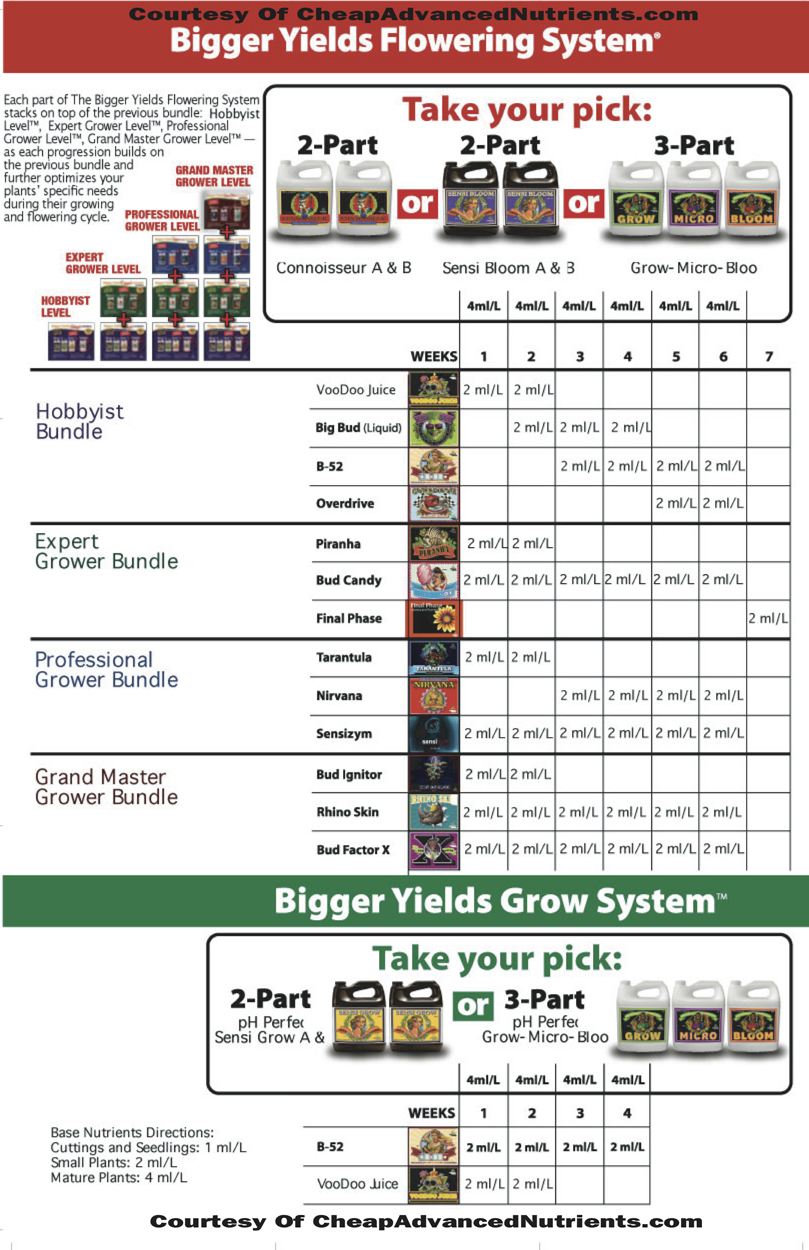
A feeding chart is a map, not a contract. That is the first lesson every new hydroponic grower should learn. Advanced Nutrients provides ready-to-use feed charts for different base nutrient lines, and those charts are helpful because they give you a week-by-week starting point. The mistake is treating the chart like every garden, every cultivar, every light, every reservoir, and every room temperature will behave exactly the same way. They will not.
When you open a chart, your goal is not to prove you can follow every line at full strength. Your goal is to understand what the chart is trying to do. A good feed chart tells you which base nutrient to use, when the crop is considered to be in vegetative growth or bloom, what additives belong in each stage, and whether the quantities are listed in milliliters per liter or milliliters per gallon. Once you understand that structure, you can begin making careful decisions instead of guessing.
Start With the Base Nutrient Line
The first practical question is simple: which base nutrient are you using? Advanced Nutrients publishes charts for several base programs, including pH Perfect Sensi Grow & Bloom, pH Perfect Sensi Coco Grow & Bloom, pH Perfect Connoisseur Grow & Bloom, pH Perfect Connoisseur Coco Grow & Bloom, pH Perfect Grow Micro Bloom, Jungle Juice Grow Micro Bloom, and OG Organics Iguana Juice Grow & Bloom. Those names matter because the base nutrient is the foundation of the schedule.
If the chart is built for Sensi Coco and you are growing in coco, that chart is speaking directly to your medium. If the chart is for a standard hydroponic base and you are using a recirculating system, you still need to watch reservoir strength, water temperature, and plant response. If you are working in a soil-like mix, the chart may still be useful, but the medium may already contain nutrition, and that changes how aggressively you should feed.
Before you write anything on a mixing cup, confirm three details: the product line, the growing medium, and the measurement system. A surprising number of feeding problems start because a grower used the wrong chart or read ml/L as ml/gal.
Understand What Each Week Is Trying to Support
Most beginner charts are arranged by growth stage. Early vegetative weeks support root establishment, leaf formation, and steady structure. Later vegetative weeks usually carry stronger base nutrition because the plant has more leaves, more root mass, and more demand. Bloom weeks shift the emphasis toward flowering support, and late bloom often reduces or changes inputs as the plant approaches the finish.
That sequence is useful, but your plant does not know what week number is printed on the paper. A small plant that had a slow start may not be ready for the same feed strength as a vigorous plant under strong light. A newly transplanted crop may need a gentler mix for a few days. A plant in a warm room may drink more water, which can concentrate nutrients in the root zone if the grower does not pay attention.
Use the week numbers as a timeline, then compare that timeline to the actual garden. Are the plants actively growing? Are leaves standing naturally? Are roots healthy and white? Are leaf tips clean, or are they turning brown? Those observations decide whether you hold steady, increase strength, or back off.
Convert Measurements Carefully
Advanced Nutrients charts may be available in Global ml/L and USA ml/Gallon versions. The distinction is not cosmetic. One gallon is about 3.785 liters, which means a 4 ml/L recommendation is roughly 15.1 ml per gallon. Many growers round that to 15 ml or 16 ml per gallon when working practically, but they should know what they are doing and keep notes.
Here is the clean way to convert: multiply the ml/L number by 3.785 to get ml per U.S. gallon. For example, 2 ml/L is about 7.6 ml per gallon. If you are mixing five gallons, multiply the per-gallon number by five. That gives you the total amount of that product for the reservoir.
Do not estimate directly from the bottle cap unless the cap is clearly measured. Use a syringe, pipette, graduated cylinder, or marked measuring cup. Hydroponic feeding works best when you can repeat your results.
Begin Below Full Strength When Conditions Are Unproven
New growers often feel safer following the printed number exactly. In practice, a cautious start is usually more useful. If you do not know how a cultivar feeds, how strong your light is, or how your water behaves, begin at a reduced strength and move upward only when the plant shows it can use the nutrition.
A common beginner approach is to start around one-half to three-quarters of the chart strength for young or sensitive plants. This is not a universal rule, but it is a safer habit than pushing full strength into an untested garden. If the plant remains pale and vigorous, you can increase gradually. If leaf tips burn or the plant darkens heavily, the solution may be too strong.
The reason this works is simple: underfeeding is usually easier to correct than severe overfeeding. A plant that needs more nutrition can often be brought up over the next few irrigations. A root zone loaded with excess salts may require dilution, runoff, reservoir changes, or a reset.
Watch the Plant, Not Just the Schedule
A chart cannot see your garden. It cannot tell whether your room is hot, whether the reservoir has drifted, whether the roots are oxygenated, or whether the plant is recovering from stress. You have to read the crop.
Useful signs include leaf color, leaf posture, growth speed, internode spacing, root appearance, runoff behavior, and tip condition. Light green new growth may be normal if it darkens over a day or two. Deep, shiny, overly dark leaves can suggest excess nitrogen. Burnt tips may indicate strength is high, although environmental stress can also contribute. Slow growth after a nutrient increase is a sign to pause and evaluate.
Beginners should keep a short feeding log. Record the date, week of growth, products used, amount per gallon or liter, pH if measured, EC or PPM if measured, and the next-day plant response. After two or three weeks, the log becomes more valuable than memory.
Use the Nutrient Calculator as a Planning Tool
The Advanced Nutrients calculator is useful because it helps growers generate a schedule around selected products. That said, the calculator still produces a starting plan. You remain responsible for matching that plan to plant size, water quality, medium, and local regulations.
The best way to use the calculator is before you buy. Choose the base nutrient you intend to run, review the additives included, and estimate how much solution you will mix each week. This prevents a common budget mistake: buying a large collection of additives before you know how often each one appears in the schedule.
For a small garden, certain products may only be used during limited windows. Planning ahead helps you decide whether small bottles are enough for a first run or whether larger sizes make sense.
Avoid the Most Common Feeding Chart Mistakes
The first mistake is mixing products as concentrates. Do not pour Part A and Part B together before adding water. Add one product to the reservoir, mix thoroughly, then add the next. The second mistake is using the wrong unit system. The third is increasing every product at once when the plant looks hungry. Make one change at a time when possible.
Another common mistake is ignoring plain water days or reservoir maintenance. Nutrients are only part of the system. Oxygen, temperature, root cleanliness, and irrigation timing all affect uptake. A well-mixed solution in a neglected reservoir is still a problem.
Finally, do not chase a perfect number at the expense of plant health. Charts, calculators, EC meters, and pH pens are tools. The plant is the final report.
Conclusion
An Advanced Nutrients feeding chart can simplify a hydroponic garden, but only when the grower understands how to read it. Start with the right base line, confirm the units, adjust strength gradually, and keep notes. Feed charts are most powerful when they help you observe better, not when they replace observation.
Tak Away: Choose your base nutrient, download or generate the appropriate chart, and create a simple feeding log before your next mix. That one habit will prevent more mistakes than any single product purchase.