A feeding schedule should make growing easier, not more confusing. For new and moderately experienced gardeners, the challenge is usually not a lack of products; it is knowing what each product is supposed to do, when it belongs in the crop cycle, and how to turn a chart into a calm weekly routine. How to Read an Advanced Nutrients Feeding Schedule Without Getting Overwhelmed is written for growers who want a practical, label-first explanation that can be used with hydroponic systems, coco, soilless mixes, and other controlled garden setups. The goal is to help you understand the logic behind the schedule so you can read manufacturer materials more confidently, avoid unnecessary complications, and make careful observations before changing your plan.
Start With the Role of the Product or Schedule
The first step is to identify whether the topic is about a base nutrient, an additive, a measurement method, or a planning tool. Base nutrients provide the core nutritional foundation for the crop. Additives are usually designed to support a more specific purpose, such as root-zone establishment, mid-bloom support, late-stage finishing, or stress support. A calculator or downloadable chart is different again: it is a planning tool that helps organize timing and measurement. When a grower confuses these categories, the schedule can become crowded quickly. For advanced nutrients feeding schedule, the best approach is to ask one simple question: what problem is this element supposed to solve in my garden?
Advanced Nutrients' public materials place strong emphasis on pH Perfect base nutrients, feeding charts, and a nutrient calculator. That positioning creates a useful editorial opportunity: many growers are searching for plain-language explanations of how to use a schedule without overfeeding, skipping label instructions, or assuming that every additive is mandatory. A good article should therefore teach process, not hype. It should describe what a product category is for, what observations matter, and why consistency is more valuable than constant experimentation.
Build the Schedule Around Crop Stage
Most feeding plans become easier to understand when they are divided into stages. Early growth focuses on establishment, root development, and steady vegetative expansion. The transition period requires close attention because plants may begin changing their nutritional priorities. The flowering or fruiting stage places different demands on the crop, and late-stage finishing is generally where growers become most tempted to add too many products at once. Instead of treating the schedule as a shopping list, treat it as a staged map. Each week should have a reason.
For a topic like how to read an advanced nutrients feeding schedule without getting overwhelmed, stage-based thinking prevents the common mistake of using all available products at full strength simply because they appear on a chart. Manufacturer schedules are designed around ratios and timing. The grower still needs to consider crop type, container size, media, water quality, environmental conditions, and plant response. A small garden with young plants may not behave the same way as a mature, dialed-in garden. That is why the safest educational advice is to begin with label directions, make changes gradually, and document what happened before making another adjustment.
Understand Measurements Before You Mix
Measurement errors are among the easiest problems to prevent. Feeding charts may use milliliters per liter, milliliters per gallon, or another unit system. Before mixing, confirm the unit, the reservoir size, and whether the amount applies to each individual product or the total formula. Use clean measuring tools, label them clearly, and avoid guessing. If you scale a recipe, scale all components consistently. A chart that works for one gallon cannot be casually estimated for a different volume without doing the math.
Good mixing habits also protect the nutrient solution. Add products to water one at a time, stir thoroughly between additions, and never combine concentrated products together before dilution unless the label specifically allows it. Keep bottles sealed, store them as directed, and avoid contaminating the cap or bottle opening with dirty tools. These simple habits are not glamorous, but they help keep a feeding routine repeatable. Repeatability is what lets a grower learn from results instead of guessing what caused them.
Watch the Plant and the Environment Together
A feeding schedule is only one part of the garden system. Light intensity, temperature, humidity, airflow, root-zone oxygen, irrigation frequency, media condition, and water quality all influence how plants respond. Yellowing leaves, burnt tips, slow growth, or weak stems do not automatically prove that the schedule is wrong. They are clues that should lead to a calm review of the full environment. Changing nutrients before checking the basics can create a new problem while hiding the original cause.
For this reason, growers using advanced nutrients feeding schedule should keep short weekly notes. Record the date, crop stage, products used, solution strength if measured, water volume, visible plant response, and any environmental changes. A simple journal turns one garden cycle into useful data for the next. It also helps a grower decide whether a product or schedule actually improved consistency or whether the garden was simply benefiting from better watering, cleaner tools, or more stable conditions.
Avoid Overcomplication
New growers often believe that advanced results require a complicated shelf of products. In practice, most gardens benefit from a stable foundation first. Choose an appropriate base nutrient line, learn the chart, observe plant response, and only then consider whether a targeted additive solves a specific need. If a product has no clear purpose in the current garden, it may be better to leave it out until the grower has a baseline run for comparison. Simpler programs are easier to troubleshoot and easier to repeat.
This is especially important for moderately experienced growers who are ready to explore more specialized programs. A premium or advanced line may be designed for more dialed-in rooms, but the garden still needs stable irrigation, lighting, temperature, humidity, sanitation, and recordkeeping. How to Read an Advanced Nutrients Feeding Schedule Without Getting Overwhelmed should therefore be framed as a decision-making guide rather than a promise of guaranteed results. The stronger message is that thoughtful scheduling, careful measurement, and patient observation are what make product choices meaningful.
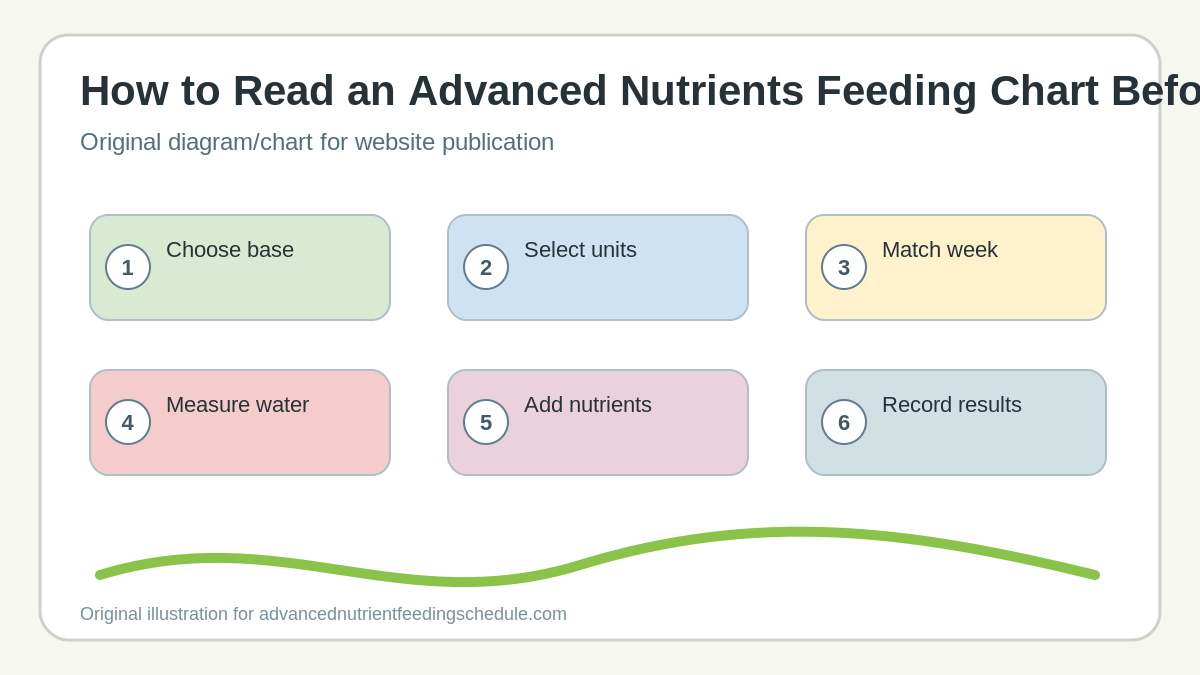
Feed Chart basic diagram.
Practical Workflow
A practical workflow keeps the garden organized: Step 1: Choose the base nutrient line that matches your experience level, crop type, and growing media. Step 2: Download or generate the correct feeding chart for the unit system you use. Step 3: Read the product labels and safety information before opening bottles. Step 4: Prepare clean water and mix one product at a time at the directed amount. Step 5: Record the week, crop stage, products, water volume, and plant response. Step 6: Make only one meaningful change at a time so results are easier to interpret. Step 7: Review notes before the next feeding instead of reacting to every small visual change.
Conclusion
The best way to approach advanced nutrients feeding schedule is to combine manufacturer guidance with disciplined garden habits. Read the chart, respect the label, understand the purpose of each product, and let plant response and records guide future adjustments. A feeding schedule is not just a list of bottles; it is a repeatable operating system for the garden. When growers keep the routine simple, clean, measured, and documented, they give themselves a better chance of improving from one cycle to the next without making avoidable mistakes. Always follow the current product label, safety data sheet, local rules, and the legal requirements that apply to your crop and location. This article is educational and does not replace manufacturer directions or professional agronomic advice.